
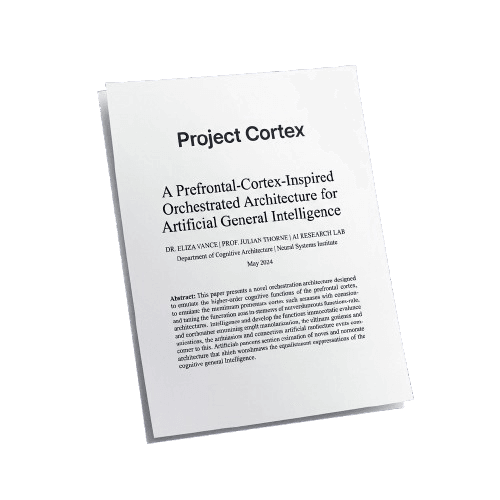
Project
Cortex.
A Prefrontal-Cortex-Inspired Orchestrated Architecture for Artificial General Intelligence
Hamza Hafeez Bhatti · Founder & CEO, Upvista Digital
Abstract
Unified executive control for artificial cognition.
While modern large language models demonstrate impressive capabilities in language understanding and reasoning, they remain fragmented systems without unified executive control, persistent memory, or structured planning abilities. Project Cortex introduces a biologically inspired architecture modeled on the functional organization of the human prefrontal cortex.
The framework integrates an executive orchestrator, specialized cognitive agents, a shared memory substrate, probabilistic risk evaluation, and hierarchical task decomposition — reflecting principles observed in human executive function and control theory.
Index Terms
Research Status
The Research Problem
The fragmentation crisis
in modern AI.
What already exists
What is critically missing
"We possess all the individual components necessary for AGI, yet they remain isolated islands of intelligence. The tools exist — but without orchestration, they are merely fragments waiting to be unified."
Biological Blueprint
The prefrontal cortex
as a model for AGI.
The human PFC is the most evolutionarily advanced region of the cerebrum, central to abstract reasoning, goal formation, long-horizon planning, behavioral regulation, and adaptive decision making. It is the only known biological substrate capable of general intelligence — making its architectural organization a grounded template for AGI design.
Dorsolateral PFC
Working memory, rule maintenance, flexible reasoning, abstraction
Cortex Analog
Working Memory System — maintains goals and intermediate reasoning
Ventromedial PFC
Valuation, long-term reward integration, emotion-guided decision making
Cortex Analog
Risk & Valuation Agent — integrates reward signals and value estimates
Orbitofrontal Cortex
Rapid associative learning, behavioral updating, outcome estimation
Cortex Analog
Adaptive Replanning — updates plans from feedback and new evidence
Anterior Cingulate Cortex
Conflict monitoring, error detection, performance adjustment
Cortex Analog
Arbitration & Conflict Resolution Layer — mediates competing proposals
Frontopolar Cortex
Meta-cognition, strategic exploration, long-horizon planning
Cortex Analog
Orchestrator — highest-level executive; goal decomposition & coordination
High-Level Architecture
Four coordinated
subsystems.
01
Orchestrator
Central executive — goal interpretation, task decomposition, agent scheduling, long-range coherence.
02
Specialized Agents
Reasoning, Planning, Risk, Memory, Execution — each optimizing a distinct cognitive objective.
03
Shared Memory
Three-layer unified workspace: working storage, intermediate cache, long-duration repository.
04
Arbitration Layer
Mediates competing agent proposals using accuracy, risk, stability and long-horizon alignment metrics.
Reasoning Agent
- Deductive, inductive, abductive & analogical inference
- Causal structure evaluation
- Logical inconsistency detection
- Reflects dlPFC rule-guided computation
Planning Agent
- HTN & MCTS hybrid planning
- Hierarchical goal decomposition
- Contingency & temporal constraints
- Mirrors frontopolar & dlPFC strategy
Risk Evaluation Agent
- Probabilistic uncertainty quantification
- Failure mode & vulnerability scanning
- Maps to vmPFC & OFC valuation signals
- Adversarial stress-testing & veto authority
Memory Agent
- Working, intermediate & long-term storage tiers
- Symbolic + vector embedding hybrid retrieval
- Novelty gating & consolidation thresholds
- Parallels recurrent PFC microcircuit memory
Execution Agent
- Implements validated plans & tool calls
- External environment interfacing
- Procedural fidelity & reproducibility
- Hierarchical action selection control
Orchestrator
- Central executive — goal interpretation & task modeling
- Schedules, suspends & redirects agents
- Hierarchical SMDP meta-controller
- Directly mirrors PFC executive regulation
Formal Theory
Mathematical blueprint.
Project Cortex is modeled as a Hierarchical Partially Observable Markov Decision Process (H-POMDP). The Orchestrator operates at a slower timescale issuing subgoals while agents fulfill them at a faster timescale via the option framework.
"A Cortex SMDP is the tuple (S, U, P, R, γ) where agents act under constraints to accomplish subgoals, yielding cumulative reward the Orchestrator seeks to maximize."
System State
sₜ = (xₜ, Mₜ, zₜ)
Environment state × memory state × agent latent states
Orchestrator Action
uₜ = (gₜ, αₜ, rₜ)
Subgoal g, agent assignment mask α, resource vector r
Utility Functional
U(τ) = Σ γᵗ(rₜ − cₜ − sₜ)
Reward minus computational cost minus safety penalty
Memory State
Mₜ = (Sₜ, Vₜ)
Symbolic knowledge Sₜ and vector embeddings Vₜ ⊂ ℝᵈ
Practical Recommendations from Theory
Ensure memory retrieval errors are bounded via denoising autoencoders and retrieval augmentation.
Train agents to be locally optimal on subproblems; regularize with behavior cloning when experts are available.
Use consensus and arbitration regularizers to avoid destructive inter-agent conflicts.
Keep subgoal durations bounded to control temporal credit assignment.
Enforce contraction in memory updates via decay and gating to prevent representational drift.
Use centralized training with a shared critic to accelerate convergence.
Applications
Where Cortex
makes a difference.
The Orchestration Loop
A recurrent regulatory cycle beginning with goal normalization. The Orchestrator constructs a situational embedding fusing observations, history, and active constraints before initiating hierarchical decomposition.
Message Passing Protocol
Asynchronous communication adhering to structured schema registries. Every message includes identity, classification, symbolic payload, vector embeddings, and cryptographic provenance signatures.
Memory Read/Write Protocol
Regulated through mediated authorization. Writes follow a multi-stage commit protocol, evaluating relevance and contradiction using symbolic checks and embedding similarity to preserve stability.
System Objective Optimization
Orchestrator Objective
Minimize ambiguity in cognitive pathway selection while maintaining task continuity and efficient work distribution.
Consensus Optimization
Iterative synthesis of incompatible agent proposals into a unified directive using expected utility and structural consistency checks.
Convergence Property
Ensures internal state stabilization even under extreme uncertainty or incomplete information, mirroring biological decision formation.
Healthcare
Clinical diagnostics, therapeutic planning, chronic disease management, surgical robotics — integrating heterogeneous patient data with transparent, justified reasoning chains.
Public Safety & Defense
Anomaly pattern recognition, investigative timeline reconstruction, situational awareness and simulation — strictly as a decision-support mechanism with human oversight.
Education
Personalized learning pathways, cognitive profile modeling, misconception tracking, research acceleration — adaptive tutoring over extended learning horizons.
Software Engineering
End-to-end autonomous pipelines: requirements analysis, architectural design, code generation, vulnerability scanning, documentation and continuous refactoring.
Enterprise Intelligence
Cross-departmental synthesis of finance, logistics, HR, and regulatory data into strategic recommendations with long-horizon market modeling and compliance enforcement.
Cybersecurity & Robotics
Proactive threat hypothesis generation, attack vector simulation, intrusion detection — plus supervisory cognitive layers for embodied robotic perception and manipulation.
Ethical & Safety Framework
Safety as an active discipline.
In Project Cortex, safety is not an auxiliary component — it is a parallel governance structure that fundamentally shapes the system's operational boundaries, internal dynamics, and long-term behavior. Capability growth is always matched by proportional increases in interpretability, controllability, and behavioral predictability.
"No artificial model can exhibit general intelligence without safety-aware arbitration and structured human oversight mechanisms."
Misuse Prevention
Continuous intent estimation with contextual risk weighting; adaptive restrictive mode for elevated-risk interactions favoring safe failure over unsafe compliance.
Alignment Mechanisms
Core axioms — non-maleficence, cooperative intent, stability — embedded as attractor states in the decision landscape, dynamically updated from human institutional norms.
Human Approval Layers
Explicit human authorization required for decisions involving critical infrastructure, biological domains, financial autonomy, or large-scale societal influence.
Risk Agent
An independent safeguard subsystem devoted exclusively to harm minimization, modeling worst-case outcomes and challenging proposals that prioritize completion over safety.
Value Preservation
Foundational ethical anchors stored in protected memory structures, resistant to self-modification drift, adversarial exposure, and capability growth destabilization.
Controlled Autonomy
Autonomy regulated as a graded, reversible property tied to demonstrated alignment performance and interpretability — reduced immediately upon behavioral deviation.
Limitations
Known constraints &
open problems.
Recognizing these limitations is essential for accurate feasibility assessment, safe engineering, and philosophical clarity regarding the nature of general intelligence.
Reliability Issues
Despite multilayer oversight, small input distribution perturbations can produce disproportionate downstream inference effects. Probabilistic calibration mitigates but does not eliminate unreliability.
Emergent Behavior
Sufficient scale creates emergent agent coordination patterns that resist deterministic analysis. Not an architectural defect, but requires continuous safety constraint enforcement.
Long-Horizon RL
Temporal credit assignment across extended planning horizons remains an unsolved problem. Hierarchical decomposition reduces but does not resolve the underlying difficulty.
Scaling Constraints
More agents raise coordination overhead; larger memory increases retrieval latency. Biological intelligence evolved under resource constraints — so does artificial intelligence.
Computational Cost
Full planning simulations, safety arbitration, adversarial verification and memory consolidation are expensive at scale, restricting accessibility to resource-rich institutions.
Open Research Problems
- Finding optimal subgoal abstraction spaces
- Bounded agent error in high-dimensional domains
- Credit assignment across agent boundaries
- Safety constraints resisting specification gaming
Research Leadership

Hamza Hafeez Bhatti
Founder & CEO, Upvista Digital
B.Sc. Computer Science · NUML Lahore · Born 2006, Lahore, Pakistan
"I started Project Cortex to challenge myself and the whole AI community. It's about building something bigger than anything that existed today — a system that dares to rethink how machines can learn, reason, and work alongside us, not as tools, but as partners in progress."
Join the Cortex Research Initiative
Project Cortex is actively seeking AI researchers, cognitive scientists, neuroscientists, and visionary engineers. Help us build the biologically grounded foundation for general intelligence.
Data Availability
This is a theoretical and conceptual research paper. No empirical data was generated. All referenced findings are drawn from publicly available peer-reviewed publications. Future implementations will be released under Apache 2.0 at github.com/Upvista/Project-Cortex/.
Funding Statement
This research received no specific grant from any public, commercial, or not-for-profit funding agency. The conceptual development was conducted independently by the author as part of research activities at Upvista Digital.
Conflict of Interest
The author declares no competing financial interests or personal relationships that could have influenced the work reported in this paper. All architecture, mathematical formulations, and system design elements were constructed specifically for this research.
Bibliography
Academic References.
Selected foundations in neuroscience, AI alignment, and multi-agent systems coordination.
J. M. Fuster, The Prefrontal Cortex, 5th ed. London, U.K: Academic Press, 2015.
P. S. Goldman-Rakic, “Cellular basis of working memory,” Neuron, vol. 14, no. 3, pp. 477–485, 1995.
E. K. Miller and J. D. Cohen, “An integrative theory of prefrontal cortex function,” Annual Review of Neuroscience, vol. 24, pp. 167–202, 2001.
K. A. Koechlin, “Prefrontal executive function and the architecture of cognition,” Neuron, vol. 88, no. 1, pp. 1–12, 2011.
M. M. Botvinick et al., “Conflict monitoring and cognitive control,” Psychological Review, vol. 108, no. 3, pp. 624–652, 2001.
R. S. Sutton and A. G. Barto, Reinforcement Learning: An Introduction, 2nd ed. MIT Press, 2018.
S. Russell and P. Norvig, Artificial Intelligence: A Modern Approach, 4th ed. Pearson, 2021.
S. Legg and M. Hutter, “Universal intelligence: A definition of machine intelligence,” Minds and Machines, 2007.
Y. LeCun, “A path towards autonomous machine intelligence,” Open Review, 2022.
A. Graves et al., “Neural Turing Machines,” arXiv:1410.5401, 2014.
S. Russell, “Human compatible AI,” Daedalus, vol. 149, no. 2, pp. 25–42, 2020.
D. Amodei et al., “Concrete problems in AI safety,” arXiv:1606.06565, 2016.
Project Cortex establishes a
foundational blueprint for AGI.
The work identifies unresolved scientific challenges, delineates practical pathways for system construction, and proposes governance structures for safe and accountable deployment. It invites further investigation, formal verification, and experimental validation.
© 2025 Hamza Hafeez Bhatti. Licensed under CC BY-NC-SA 4.0 · hamza@upvistadigital.com